Explore / 02
Skin & hair
A considered look at nourishment, beauty supplements and the claims that connect them. We ask what is known, what is uncertain and what a label leaves out.
Start here
Skin and hair, beyond the beauty supplement
Biotin, collagen and the difference between a nutrient’s role and a visible result.
Read the full guide ↗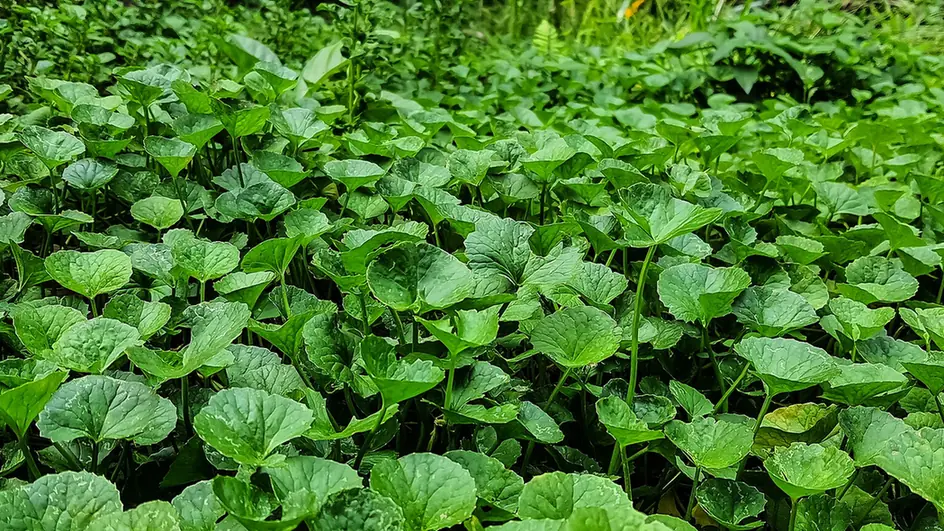
Gotu kola · pegagaGlow habits from the garden, not the hype
East meets West · the research
Research from Asia on this topic
Studies published in Japanese, Korean, Malaysian, Chinese and TCM journals, read with the same care as our other sources. Some were published in Japanese, Korean, Chinese or Malay; we show the original title and an English translation, and summarise them in plain English. We note small samples, animal studies and company-run trials. These summaries describe what was studied; they are not promises of results for you.
- Korea
Lee JS, Yoon YC, Kim JM, et al. (2024). Liquid collagen from freshwater fish skin ameliorates hydration, roughness and elasticity in photo-aged skin: a randomized, controlled, clinical study. Nutrition Research and Practice (Korea).
In plain English: A 12-week randomized, controlled trial by a Korean ingredient maker; a liquid freshwater-fish collagen drink improved measured skin hydration, roughness and elasticity versus placebo in adults with sun-aged skin. Run by the ingredient maker.
- Malaysia / SE Asia
Ng JY, Wong QYA, Lim JJ, et al. (2025). A broad assessment of forty-one skin phenotypes reveals complex dimensions of skin ageing. Journal of Physiological Anthropology (Japan) · Singapore/Malaysia cohort.
In plain English: A broad survey of 41 visible signs of skin ageing in an Asian cohort, showing that ageing involves far more than wrinkles, including pigmentation, dryness, eye bags and lip changes. Descriptive research.
- Japan
Koizumi S, Okada Y, Miura S, et al. (2023). Ingestion of a collagen peptide containing high concentrations of prolyl-hydroxyproline and hydroxyprolyl-glycine reduces advanced glycation end products levels in the skin and subcutaneous blood vessel walls: a randomized, double-blind, placebo-controlled study. Bioscience, Biotechnology, and Biochemistry (Japan).
In plain English: A 12-week randomized, placebo-controlled trial by a Japanese collagen manufacturer; a fish collagen peptide lowered levels of advanced glycation end products (AGEs) measured in skin. Run by the manufacturer, and AGE levels are not the same as visible skin change.
- Japan
Matsushita A, Kameda N, Seike M (2012). 健常成人女性の皮膚機能に対する大豆ペプチドならびにコラーゲンペプチドの同時摂取効果 [Effects of taking soy peptide and collagen peptide together on the skin of healthy adult women]. 日本家政学会誌 (Journal of Home Economics of Japan) 63(1):35–42. Japan.
Japanese Published in Japanese; summary translated by Open Leaf from the Japanese abstract.
In plain English: For 70 days, healthy women drank either a soy-plus-collagen peptide drink or a collagen-only drink. The two drinks did not differ in their effect on skin elasticity, moisture or water loss. In the soy-plus-collagen group, elasticity rose and water loss fell compared with before. With no placebo drink, read this as a hint, not proof.
- Japan
荻野明彦, 岡村健史, 山村聡, 横野智砂子, 野村義宏 (2024). 魚皮由来コラーゲンペプチド摂取による被験者の安全性および皮膚への効果 [Safety and skin effects of taking fish-skin collagen peptide]. Functional Food Research 20:97–104. Japan.
Japanese Published in Japanese; summary translated by Open Leaf from the Japanese abstract. Author names are shown as published.
In plain English: In a randomized, double-blind trial, 38 adults took 2.5 g or 12.5 g of fish-skin collagen peptide, or a placebo, for 8 weeks. Routine blood tests did not change, even at five times the usual amount. Skin moisture trended higher but the difference was not statistically significant, and skin water loss was lower in the 2.5 g group. Some authors work for private companies.
- Korea
Hyun MY, Suk JM, Jung SW, Park JO, Kim BH, Jang JD, Joe GJ, Yeo IK, Kim BJ, Kim MN (2013). 홍삼사포닌 Rg3가 함유된 샴푸의 탈모방지와 양모개선 효과 [The effect of a shampoo containing red ginseng saponin Rg3 on preventing hair loss and improving hair growth]. 대한화장품학회지 (Journal of the Society of Cosmetic Scientists of Korea) 39(3):187–194. South Korea.
Korean Published in Korean; summary translated by Open Leaf from the Korean abstract.
In plain English: Forty-two adults with diagnosed hair loss used either a shampoo with 0.003% ginsenoside Rg3 or the same shampoo without it for 16 weeks. The Rg3 group showed greater hair density, thickness and growth rate, and rated the shampoo higher. The trial was run with the shampoo’s maker and tested a shampoo, not a supplement. It does not show that ginseng prevents hair loss in general.
Each record was checked against PubMed, J-STAGE, KoreaScience or the DOI registry on 14–15 November 2026. Translations are Open Leaf’s own; please check the original for exact wording. Not medical advice.